PEPStar utilizes Starlink, IoT technologies and cloud computing for real-time weather monitoringand disaster alerts. It continuously monitors environmental parameters through a network of weather stations, ensuring communities stay informed and prepared for extreme weather events.
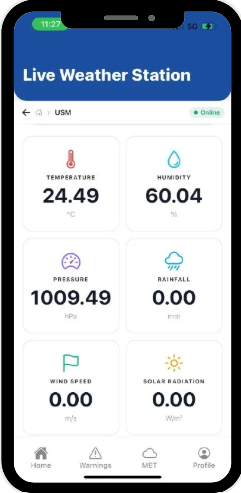
Each weather station simultaneously measures six environmental parameters, all displayed on a single dashboard screen.
Traditional IoT deployments fail when terrestrial infrastructure goes down — exactly when disaster monitoring matters most. PEPStar addresses this by leveraging Low Earth Orbit (LEO) satellite connectivity to keep every station online, regardless of ground-level disruptions.
LEO satellites orbit at 550 – 1,200 km altitude, delivering round-trip latency of 20 – 40 ms — up to 60× lower than traditional geostationary satellites. This makes real-time sensor telemetry and instant alert delivery achievable over satellite links.
Weather stations in rural, coastal, and highland areas often have no fibre or 4G coverage. Starlink provides broadband-grade uplinks directly to each station, eliminating the single point of failure that terrestrial ISPs represent during floods or earthquakes.
When ground infrastructure is damaged by the very disasters PEPStar monitors, the satellite backhaul continues transmitting sensor readings and push notifications — ensuring alerts reach responders and communities at the moment they need them most.
Weather stations are only as useful as their data. PEPStar's feature set is designed to ensure that every reading, alert, and insight is delivered reliably — even when the ground-level infrastructure is compromised.
Continuous readings of temperature, humidity, pressure, rainfall, wind speed, and solar irradiance — streamed in real time from each registered station, latest reading updated every 5s.
All stations plotted on a live map with colour-coded pins that instantly communicate each station's overall alert status at a glance.
Real-time disaster alerts are automatically triggered when any sensor reading breaches predefined thresholds — ensuring no critical event goes unnoticed. (Threshold-based disaster warning based on MET Malaysia Warning Criterias)
Historical charts let administrators spot recurring weather patterns, validate sensor health, and generate reports for disaster preparedness planning.
Critical alerts are pushed directly to mobile devices so field teams and public users receive warnings immediately — even when the app is in the background.
Official warnings from MET Malaysia Open Data API are integrated alongside station readings, giving users both ground-truth measurements and official issued warnings in one view.
The admin dashboard brings together live sensor data, station management, station health, and overview of disaster warnings triggered by weather stations. It’s the nerve centre for monitoring and responding to weather events in real time.
The PEPStar mobile app delivers real-time weather readings and disaster alerts directly to residents and field teams. Receive instant push notifications when hazard thresholds are breached, and view live station data from anywhere.
Built With
AWS IoT Core
AWS DynamoDB
AWS Lambda
AWS API Gateway
AWS Cognito
React
React Native
MQTT
Amazon Web Services
AWS IoT Core
AWS DynamoDB
AWS Lambda
AWS API Gateway
AWS Cognito
GitHub
Google
MET Malaysia
Scan the QR code with your Android phone
or confirm below to download directly.
Scan to Download